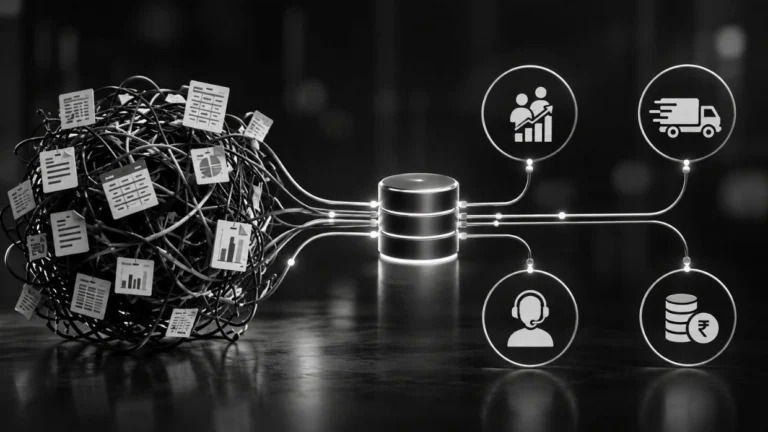
Most manufacturing organizations fall somewhere along a maturity spectrum—from disconnected operations that limit AI impact to structured environments where AI delivers measurable business outcomes. This model helps you understand where your organization currently operates and what the path forward looks like.
Production planning built on historical patterns plus “what we heard in meetings”
Operational teams translate sales inputs rather than working from aligned data
Service and Lifecycle:
Limited visibility into what was sold, how it’s configured, and what commitments exist
Service teams research context for each interaction through emails, calls, and file searches
Product ownership and entitlements not consistently tracked across the lifecycle
Resolution times extended by information access barriers
Decision-Making:
Performance reporting requires manual data extraction and consolidation
Visibility strongest at outcome level; understanding how outcomes are constructed requires additional effort
Cross-functional coordination depends on meetings, emails, and personal relationships
Decision consistency varies based on who’s involved and current business pressure
AI Impact at This Stage: AI generates reports and recommendations, but execution still requires manual interpretation and coordination. The business gets insights about what happened, not operational leverage to change what happens next.
Stage 2: Connecting the Critical Paths
Transition State
Organizations at this stage have identified the operational disconnects and are working to establish structured connections across critical areas.
What’s Being Built:
Consistent Revenue Construction:
Pricing, configuration, and commercial terms moving into governed frameworks
Quote validation becoming systematic rather than manual
Exception visibility improving through defined approval workflows
Margin impact of deal structure visible during construction, not after execution
Aligned Demand and Execution:
Customer commitments, forecasts, and orders being captured in formats operations can directly consume
Demand translation shifting from manual coordination to structured data models
Production planning beginning to work from aligned signals rather than reconciled inputs
Inventory decisions informed by actual commitments rather than historical patterns alone
Lifecycle Visibility:
Product configurations and customer entitlements being tracked across delivery and service
Service teams gaining direct access to context rather than researching each interaction
Contract obligations and performance metrics becoming visible during execution
Renewal and expansion opportunities surfacing through structured lifecycle data
Operational Coordination:
Cross-functional impacts of decisions becoming visible through connected systems
Manual coordination decreasing as information flows through defined processes
Reporting cycles shortening as data preparation requirements reduce
Decision-making supported by accessible, consistent information
AI Impact at This Stage: AI begins operating on structured data in specific areas. Value emerges where connections exist—revenue construction monitoring in some product lines, demand alignment for specific customer segments, service context for certain product families. Impact is measurable but localized.
Stage 3: Structured for Operational Leverage
Future State
Revenue Construction:
Pricing, configuration, and commercial terms applied within defined, governed systems
Deal structure variance identified in real time while quotes are being built
Margin impact visible and controllable before deals reach production
Exception handling systematic; consistency maintained across deal complexity
Demand and Execution:
Customer commitments directly connected to production and inventory planning
Demand signals—orders, forecasts, agreements—translate without manual reconciliation
Production aligned to actual customer requirements, not interpreted intent
Inventory decisions informed by forward-looking commitments and real-time consumption
Service and Lifecycle:
Full visibility into what was sold, configuration details, and customer entitlements
Service execution supported by immediate access to product and contract context
Lifecycle events (installations, renewals, expansions) tracked and actionable
Cost-to-serve reduced through efficient resolution and reduced escalation
Operational Coordination:
Decisions in one area automatically surface impacts in affected functions
Cross-functional coordination supported by shared visibility into structured data
Performance continuously evaluated; relevant information presented at point of decision
Reporting effort focused on action rather than data assembly
AI Impact at This Stage: AI operates as an integrated capability across the business. It continuously monitors revenue construction, identifies demand misalignment, surfaces agreement risk, highlights cross-functional impacts, supports service execution, and maintains decision consistency—at speed and scale manual processes cannot match.
The result: measurable impact across revenue predictability, margin performance, and operational cost.
Identifying Your Current Stage
Diagnostic Questions:
Revenue Construction:
Can you identify pricing or margin issues while deals are being quoted, or do you discover them after execution begins?
Is pricing consistency maintained through systematic governance or individual interpretation?
Demand and Execution:
Do your production plans work from actual customer commitments, or from reconciled interpretations of demand signals?
How many steps exist between a customer forecast and a production plan?
Service and Lifecycle:
Can service teams see what was sold and what’s owed without researching or asking other teams?
Are lifecycle obligations tracked systematically or managed reactively as they arise?
Coordination and Decision-Making:
Does cross-functional coordination happen through systems or through meetings?
How much time is spent assembling data versus acting on it?
If most of your answers point to manual processes, interpretation, and reactive coordination, you’re operating in Stage 1.
If you’re actively working to connect systems and establish governance in specific areas, you’re in Stage 2.
If coordination happens systematically and information flows through defined processes across most areas, you’re approaching Stage 3.
“Many manufacturers are investing in AI before building the operational readiness required to support it.” Source: Forbes Tech Council
The Path Forward: What It Takes to Advance
From Stage 1 to Stage 2:
Focus: Identify and Connect the Critical Paths
Start where disconnects create the most financial impact:
Revenue construction and pricing governance
Demand alignment between what’s sold and what’s built
Service visibility into what’s been delivered and what’s owed
Don’t try to fix everything at once. Connect one critical path, prove the value, then expand.
What this requires:
Honest assessment of where information exists and who needs access to it
Executive alignment on which operational gaps are costing the most
Willingness to change processes, not just implement technology
Focus on structure and governance, not just system connections
From Stage 2 to Stage 3:
Focus: Expand and Systematize
With initial connections proving value, expand structured operations across:
All product lines and customer segments
Full lifecycle from quote through delivery to service and renewal
All functions that depend on consistent information to execute effectively
What this requires:
Systematic governance that scales beyond initial implementations
Data integrity maintained as complexity increases
Process discipline that persists regardless of business pressure
Measurement of business outcomes, not just operational metrics
Why This Progression Matters
AI delivers value proportional to the structure it operates on. At Stage 1, AI generates reports. At Stage 2, AI provides localized operational support. At Stage 3, AI becomes an integrated capability that continuously evaluates performance and supports faster, more consistent execution.
The businesses winning in manufacturing aren’t necessarily the ones with the most sophisticated AI. They’re the ones who built the operational foundation that allows AI to work.
What Comes Next
Understanding where you are on this maturity model is the first step. The next is determining what it will take to advance—and whether the value of that advancement justifies the effort and change required.
We work with manufacturing leaders who are navigating this maturity progression—building the operational foundation that makes AI meaningful while managing ongoing operations, existing system investments, and organizational change.
Our focus is on establishing the structured, connected environment where AI delivers measurable impact across revenue predictability, margin performance, and operational cost.
Ready to discuss where you are and what comes next?
External pressures are accelerating the need for operational maturity:
Customer demand influenced by supply chain dynamics you don’t control
Competitive capabilities advancing as some organizations improve coordination through connected data
Growth through acquisition introducing systems and models that must function as one business
The question isn’t whether to advance. It’s whether you advance intentionally or find yourself forced to by competitive or market pressure.
The organizations that move deliberately—building the foundation before the pressure peaks—are the ones that turn operational structure into competitive advantage.
Frequently Asked Questions
What is an AI readiness maturity model for manufacturing?
It is a way to see honestly where your operations, data, and systems stand for AI, and what to strengthen next. Rather than a score for its own sake, it maps the path from foundational readiness toward AI-enabled operations.
What are the three stages of AI readiness in manufacturing?
They describe rising levels of operational and data maturity: foundational readiness, then more connected and structured operations, and finally AI-enabled operations. Each stage builds the data and process discipline the next one depends on.
How can manufacturers determine their current level of AI readiness?
Look at your processes, data quality, system connectivity, automation, governance, and how easily you can reach operational information. That honest read shows the gaps worth closing before you scale AI, and it usually reflects how the business grew rather than anything done wrong.
What needs to change for a manufacturer to move from basic AI readiness to operational AI?
The move comes from better data quality, connected operational systems, standardized processes, and stronger governance. Reliable data flows are what let AI work on consistent, trustworthy information instead of guesswork.