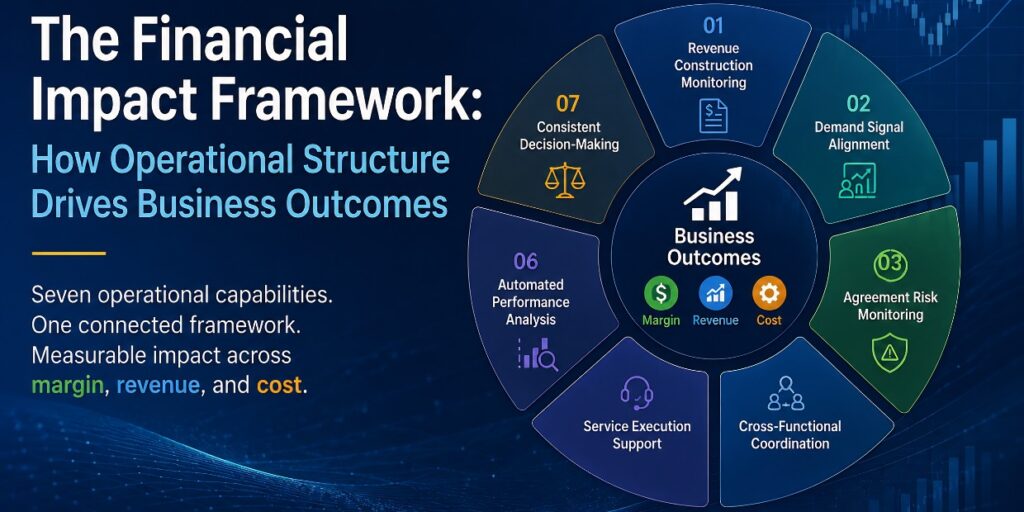
Understanding the Connection Between Operations and Financial Performance
When customer demand, revenue construction, and operational execution are consistently defined and connected, specific operational capabilities translate directly into measurable financial outcomes. This framework maps the relationship between structured operations and impact across margin, revenue, and cost.
“AI can help manufacturers improve efficiency, reduce downtime and optimize operations.” Source: Forbes Tech Council
The Seven Operational Capabilities and Their Financial Impact
Where customer demand, revenue construction, and operational execution are consistently defined and aligned, AI transforms from a reporting tool into an operational capability. Instead of generating insights that require interpretation and action, AI can continuously evaluate how the business is performing and identify where adjustment is required—with direct impact on revenue predictability, margin performance, and operational cost.
This is operational leverage. And it’s only possible when the foundation is structured.
1. Revenue Construction Monitoring
Operational Capability: AI evaluates how pricing, configuration, and commercial terms are applied across deals, highlighting inconsistencies and identifying where outcomes may differ from expectations.
Financial Impact: – Margin: Reduces margin leakage caused by inconsistent pricing and discounting – Revenue: Improves forecast reliability by aligning expected versus actual deal structure – Cost: Reduces time spent validating quotes and correcting downstream errors
What changes: Revenue variance is identified before deals close rather than after they’re in production.
2. Demand Signal Alignment
Operational Capability: Customer forecasts, order patterns, and agreement commitments are continuously compared to operational plans, allowing earlier identification of misalignment.
Financial Impact: – Margin: Reduces overproduction, excess inventory, and expedited fulfillment costs – Revenue: Improves ability to meet demand consistently, reducing missed or delayed revenue – Cost: Lowers operational inefficiencies caused by reactive production adjustments
What changes: Production plans reflect actual customer commitments rather than interpreted demand signals.
3. Agreement Risk Monitoring
Operational Capability: AI monitors actual performance against expected volumes, timelines, and service obligations, surfacing potential gaps before they impact outcomes.
Financial Impact: – Margin: Protects profitability by identifying underperforming agreements early – Revenue: Reduces revenue slippage tied to missed commitments or volume gaps – Cost: Limits downstream recovery effort and contract-related inefficiencies
What changes: Contract risks surface during execution, not during financial review.
4. Cross-Functional Coordination
Operational Capability: By operating on a shared set of structured data, AI highlights where decisions made in one area introduce downstream impact in another.
Financial Impact: – Margin: Reduces rework, misalignment, and costly downstream corrections – Revenue: Improves consistency in how deals are executed and delivered – Cost: Decreases reliance on manual coordination and cross-functional intervention
What changes: Coordination happens through systems rather than through meetings and emails.
5. Service Execution Support
Operational Capability: Access to connected information about products, configurations, and customer commitments allows AI to support faster issue resolution and more consistent service delivery.
Financial Impact: – Margin: Reduces cost-to-serve through more efficient resolution and fewer escalations – Revenue: Improves retention and renewal outcomes through better service experience – Cost: Lowers service overhead and reduces dependency on internal escalation paths
What changes: Service teams operate with full context rather than researching each interaction from scratch.
6. Automated Performance Analysis
Operational Capability: Instead of assembling data across systems to understand performance, AI continuously evaluates the business and presents relevant information at the point of decision.
Financial Impact: – Margin: Improves decision quality by reducing lag between issue and response – Revenue: Enables faster adjustments to protect or capture revenue opportunities – Cost: Reduces manual reporting effort and dependence on data preparation
What changes: Capacity shifts from assembling information to acting on it.
7. Consistent Decision-Making
Operational Capability: As demand patterns, supply conditions, and organizational structures evolve, AI helps maintain consistency in how decisions are made.
Financial Impact: – Margin: Maintains pricing and operational discipline under pressure – Revenue: Stabilizes performance despite variability in demand and supply conditions – Cost: Reduces inefficiency introduced by inconsistent or reactive decision-making
What changes: Operational discipline is systematic rather than situational.
The Cumulative Business Impact
When these operational capabilities are in place, the cumulative effect is measurable across three critical business outcomes:
More Predictable Revenue
Better alignment between customer demand, pricing decisions, and delivery execution reduces revenue variance and improves forecast accuracy.
Stronger Margin Performance
Consistent application of pricing discipline and operational coordination protects margins from leakage and reactive costs.
Lower Operational Cost
Reduced manual effort, fewer corrections, and less reactive coordination lower the cost to operate across commercial, operational, and service functions.
What This Requires
These financial outcomes are only possible when the operational foundation is structured:
Revenue construction operates within defined, governed frameworks Pricing, configuration, and commercial terms are applied consistently rather than interpreted case-by-case.
Customer demand and operational execution are directly connected Orders, forecasts, and commitments translate into production and inventory plans without manual reconciliation.
Lifecycle information is accessible across functions Sales, operations, and service work from shared visibility into what was sold, how it’s configured, and what’s committed.
Data integrity supports decision-making at speed Performance information is readily accessible in actionable formats rather than requiring assembly and preparation.
Assessing Your Current State
Where does your organization stand?
Are margin outcomes predictable or do they contain unexplained variance?
Can you identify revenue risk before it impacts financial results?
How much operational cost is attributable to coordination, rework, and manual analysis?
The answers to these questions reveal whether your operational structure supports the financial outcomes you’re working toward—or whether gaps in connectivity and consistency are limiting what’s possible.
What Comes Next
Understanding the connection between operational structure and financial impact is the first step. The next is assessing where your organization currently operates and what the path forward looks like.
Resources to continue your evaluation:
Read the full POV – Operational Leverage: What Becomes Possible with AI in a Structured Environment
We help manufacturing leaders build the operational foundation that makes AI meaningful—establishing the structured, connected environment where AI delivers measurable impact across revenue predictability, margin performance, and operational cost.
Ready to explore what this looks like for your organization? Visit simpliigence.com or contact us at sales@simpliigence.com
Frequently Asked Questions
How does operational structure affect financial performance in manufacturing?
How your operations are structured shapes how well you manage resources, production, cost, inventory, and commitments. Better structure gives you clearer visibility into performance, and clearer visibility leads to better financial decisions.
What operational capabilities have the greatest impact on manufacturing financial outcomes?
Production visibility, resource planning, inventory management, cost control, forecasting, order management, and cross-functional coordination tend to move the numbers most. Which matter most depends on how your business actually runs.
How can structured operational data improve revenue predictability and margin performance?
Structured data gives you one consistent view of activity, cost, orders, and performance. That is what makes trends visible, forecasts more reliable, and the drivers behind revenue and margin easier to understand and act on.
How can manufacturers measure the financial impact of operational improvements?
Track the operational metrics that connect to money: production cost, margin, cycle time, inventory, and order fulfillment, alongside revenue predictability, before and after the change. That is how you tie an operational improvement to a financial result.