Most manufacturing leaders we speak with are asking the same question: “How can AI improve our operations?”
But based on what we observe across the industry, that’s not quite the right question. The more important question is: “Is our operational environment structured in a way that allows AI to deliver measurable value?”
The difference matters. Because in most manufacturing environments today, the impact of AI capabilities is limited not by the technology itself, but by how consistently information about customer demand, revenue construction, and operational execution is defined and connected across the business.
Let’s explore what changes when you get this foundation right.
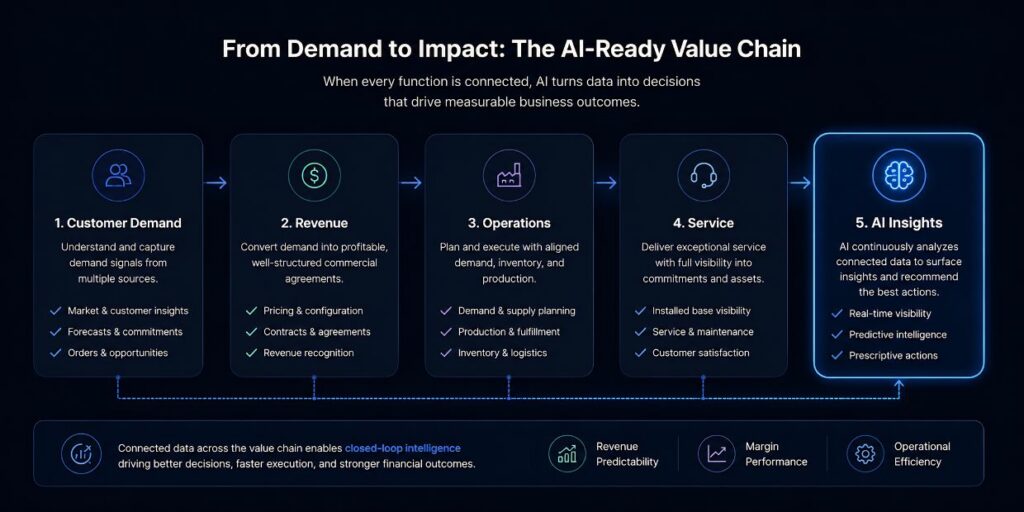
Where customer demand, revenue construction, and operational execution are consistently defined and aligned, AI transforms from a reporting tool into an operational capability. Instead of generating insights that require interpretation and action, AI can continuously evaluate how the business is performing and identify where adjustment is required—with direct impact on revenue predictability, margin performance, and operational cost.
This is operational leverage. And it’s only possible when the foundation is structured.
The Seven Operational Priorities That Define Impact
Across manufacturing organizations, we see the same operational challenges surfacing repeatedly:
Revenue Construction Monitoring – How is revenue built across deals, and where does variance occur?
Demand Signal Alignment – Are customer forecasts, orders, and commitments translating accurately into production plans?
Agreement Risk Visibility – Can you identify underperforming contracts before they impact outcomes?
Cross-Functional Coordination – Do decisions in sales automatically surface downstream impacts in operations?
Service Execution Support – Does your service team have immediate context on products, configurations, and commitments?
Manual Analysis Reduction – How much time is spent preparing data versus using it for decisions?
Decision Consistency – Can you maintain operational discipline when market conditions change rapidly?
These aren’t technology questions. They’re business questions. But when these areas are supported by structured, connected information, AI can address each one with measurable financial impact.
From Operational Challenges to Financial Outcomes
Here’s what becomes possible when AI operates on a structured foundation:
Revenue Predictability
When pricing, configuration, and commercial terms are defined and governed within connected systems, AI can evaluate how deals are structured in real time—catching inconsistencies before they reach production or delivery. This reduces margin leakage, improves forecast accuracy, and eliminates time spent correcting downstream errors.
Margin Performance
Customer commitments, production plans, and inventory decisions can be continuously monitored for alignment. AI surfaces mismatches early—before you’re sitting on excess inventory or expediting production at premium costs. It monitors agreement performance against expectations, protecting profitability by identifying underperforming contracts while there’s still time to intervene.
Operational Cost
Access to connected information across the customer lifecycle means service teams can resolve issues faster, with full context on what was sold and what’s owed. Sales teams spend less time validating deals and more time advancing opportunities. Operations teams work from aligned demand signals rather than reconciling multiple versions of customer intent.
The cumulative impact: faster execution, fewer corrections, less manual coordination.
The Current Reality: Where Most Manufacturers Operate
We understand that most manufacturing environments have evolved organically over time. CRM platforms support customer-facing activities. Pricing models and product configurations live in spreadsheets or standalone tools. Long-term agreements and customer forecasts inform demand planning but aren’t always directly connected to operational execution. ERP systems manage production and fulfillment with visibility into what’s being built, but not always full context on why or what was committed.
For organizations with significant installed bases, service operations add another layer—dependent on accurate visibility into what’s been sold, how it’s configured, and what obligations exist.
Each area functions effectively within its domain. The challenge emerges at the intersection points: – Where revenue construction meets operational execution – Where customer commitments translate into production plans – Where service obligations depend on contract and configuration visibility
These aren’t system failures. They’re coordination gaps. And they compound as complexity increases—through portfolio expansion, acquisition integration, or shifts in how customers buy and consume your products.
The result is predictable friction: sales teams validating deals rather than advancing them, pricing consistency depending on interpretation, operations reconciling demand signals, service teams extending resolution times due to limited visibility.
Meanwhile, external pressures are accelerating. Customer demand is influenced by supply chain dynamics you don’t control. Competitive capabilities are advancing as some organizations improve coordination through connected data. Growth introduces new systems and operating models that must function as a unified business.
The ability to coordinate decisions across revenue, operations, and service functions is becoming a competitive requirement.
What the Path Forward Looks Like
Organizations working toward a more connected operating model are focused on three core areas:
1. Consistent Revenue Construction Pricing, configuration, and commercial terms applied within a defined, governed framework. The objective is reducing variability in deal structure while improving visibility into margin and revenue impact.
2. Connected Demand and Execution Aligning how demand is represented—whether through orders, forecasts, or agreements—with how it translates into production planning, inventory management, and fulfillment.
3. Lifecycle Visibility Improving access to reliable information about customers, products, and commitments across the full lifecycle. This supports coordination across functions and reduces reliance on manual processes.
The strategic objective is clear: establish the structured foundation that allows AI to operate as an integrated capability rather than a separate analytical exercise.
When customer demand, revenue construction, operational execution, and lifecycle support are consistently aligned, AI can continuously assess performance, identify variance at the point where intervention is most effective, and support decision-making with context that spans the full customer relationship—at a speed and scale manual processes cannot match.
Explore where your organization falls on the AI Readiness Maturity Model →
What This Means for You
If you recognize elements of your current environment in what we’ve described, the question isn’t whether your systems are adequate today. It’s whether the foundation you have in place will support the level of coordination, consistency, and responsiveness required tomorrow.
At Simpliigence, we work with manufacturing leaders who are navigating this transition—building the operational foundation that makes AI meaningful while managing ongoing operations, existing investments, and organizational change.
Our approach focuses on establishing the structured, connected environment where AI delivers measurable impact across revenue predictability, margin performance, and operational cost.
The conversation starts with understanding where you are today and what becomes possible when the right foundation is in place.
If it feels like the platform is carrying more than it was designed to hold, that’s a useful place to start the conversation.
Frequently Asked Questions
Why is operational structure important for AI readiness in manufacturing?
AI runs on reliable information and consistent process. Structured operations make sure data is captured the same way, connected across systems, and available in a form AI can actually use.
What prevents manufacturers from getting measurable value from AI?
Usually it is fragmented data, inconsistent processes, disconnected systems, and unclear use cases rather than the AI itself. Without those foundations, even good tools struggle to produce dependable outcomes.
How does connected operational data improve AI decision-making in manufacturing?
Connected data gives AI a fuller picture of the business, so it can spot patterns and support decisions using information from across operations rather than one isolated corner.
What should manufacturers do before investing in advanced AI capabilities?
Get your foundations honest first: data, processes, systems, integrations, and governance. Closing those gaps creates the environment where advanced AI can actually deliver and scale.